



Girls on the Side
Women’s War Within and Against the Military
By Simin Lee
In 1997, the release of Ridley Scott’s film “G.I. Jane” inspired a new interest in the women of the military; America was fascinated to watch Demi Moore’s character battle and eventually conquer the challenge of proving herself in an all-male environment. This struggle is not confined to Hollywood’s vision of the military: ten years later, women in the armed forces still face the test of gaining the respect of their male counterparts. Because of significant legal restrictions on women, female soldiers will have to make their fight a legal one to achieve equality next to their male complements.
A Growing Force
As recently as the Second World War, the primary function of women in the military was to serve as nurses. Today, however, women comprise 15% of the military and are increasingly vital in both numbers and function. Of those serving in Operation Iraq Freedom, 160,500 are women, 71 of whom died and 450 of whom were wounded. Bearing these figures in mind, Erin Solaro, author of Women in the Line of Fire, points out that, “with the threat of a draft, recruiting is low, so the military needs women and cannot afford to alienate them through combat exclusion.”
Rule by Men
Despite their importance to the military, women face restrictions: most noteworthy, their exclusion from direct ground service. Dating back to a 1988 Department of Defense (DOD) policy called the Risk Rule, the “combat exclusion rule” states that “[R]isks of direct combat, exposure to hostile fire, or capture are proper criteria for closing non-combat positions or units to women.” Defenders of the rule maintain that women have less upper body strength, are a distraction to men, and could jeopardize military missions if they became pregnant while in active duty. Today, this rule and what many call unrealistic physical fitness standards exclude women from about 200 important military occupations, including infantry, field artillery, and armor.
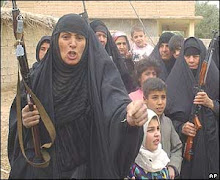
That said, many women have positive experiences serving in the military. Monica Toft, associate professor of public policy at the Harvard Kennedy School of Government, found that attitude toward women varies among different branches of the military. Having served as a Russian language interpreter in military intelligence from 1983 – 1984, Toft noted that in fields like intelligence it has been easier for men to respect their female colleagues and the Risk Rule was not a problem. Exceptions aside, the Risk Rule’s critics accuse the Pentagon of subjecting most women on the ground to second-class treatment. Indeed, Helen Benedict, Professor of Journalism at Columbia, stated that many women are “in combat situations, but are not getting combat pay.” In Iraq, these occupations involve work in the military police, air and ground transportation, search teams, and raids. In these jobs, “women are fighting in ground combat because there is no choice…[and] are coming home with missing limbs, mutilating wounds and severe trauma, just like the men,” Benedict wrote on Salon.com.
Greater Implications
The effects of this technical restriction on women extend beyond issues of pay and combat. Some suggest that the military’s treatment of women as inferiors through the Risk Rule has rendered women sexual objects. Journalist Sarah Corbett recently documented in The New York Times that, although the number of reported sexual assaults over the past few years has risen, only about one-tenth result in a court-martial of the accused perpetrators. Most other cases are either dismissed or are resolved via minor administrative punishments.
The Risk Rule may also compromise military cohesion. With the military reeling from sexual abuse scandals, men may doubt whether female comrades are strong enough to be trusted, but women also worry that the males in their units will rape or abuse them. Many fear that this imbalance of trust creates internal tension that prevents military units from effectively completing their missions.
Looking to Leaders for Answers
Are more female leaders the solution to the problem? Rutgers professor of law Elizabeth Hillman believes so. She indicated, however, that women will not be considered for promotion to the appropriate leadership positions for mitigating the effects of the Risk Rule as long as they are excluded from direct ground combat. It is only when this vicious cycle is overcome that real equality can exist within the Armed Forces.
skip to main |
skip to sidebar




Blog Archive
-
▼
2007
(38)
-
▼
October
(13)
- more info....
- http://www.vcorps.army.mil/VictoryForward/album/1a...
- women in war article
- interesting study...
- in print...
- No title
- taking on roles in your artwork...
- Continuing to think...
- Related to Performance...
- check this out
- a little info...
- with regard to my project....
- September Lecture 1, James Hyde (11am School of Ar...
-
▼
October
(13)
Contributors
No comments:
Post a Comment