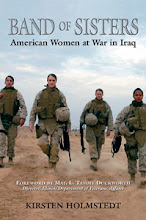
Girls on the Side
Women’s War Within and Against the Military
By Simin Lee
In 1997, the release of Ridley Scott’s film “G.I. Jane” inspired a new interest in the women of the military; America was fascinated to watch Demi Moore’s character battle and eventually conquer the challenge of proving herself in an all-male environment. This struggle is not confined to Hollywood’s vision of the military: ten years later, women in the armed forces still face the test of gaining the respect of their male counterparts. Because of significant legal restrictions on women, female soldiers will have to make their fight a legal one to achieve equality next to their male complements.
A Growing Force
As recently as the Second World War, the primary function of women in the military was to serve as nurses. Today, however, women comprise 15% of the military and are increasingly vital in both numbers and function. Of those serving in Operation Iraq Freedom, 160,500 are women, 71 of whom died and 450 of whom were wounded. Bearing these figures in mind, Erin Solaro, author of Women in the Line of Fire, points out that, “with the threat of a draft, recruiting is low, so the military needs women and cannot afford to alienate them through combat exclusion.”
Rule by Men
Despite their importance to the military, women face restrictions: most noteworthy, their exclusion from direct ground service. Dating back to a 1988 Department of Defense (DOD) policy called the Risk Rule, the “combat exclusion rule” states that “[R]isks of direct combat, exposure to hostile fire, or capture are proper criteria for closing non-combat positions or units to women.” Defenders of the rule maintain that women have less upper body strength, are a distraction to men, and could jeopardize military missions if they became pregnant while in active duty. Today, this rule and what many call unrealistic physical fitness standards exclude women from about 200 important military occupations, including infantry, field artillery, and armor.
That said, many women have positive experiences serving in the military. Monica Toft, associate professor of public policy at the Harvard Kennedy School of Government, found that attitude toward women varies among different branches of the military. Having served as a Russian language interpreter in military intelligence from 1983 – 1984, Toft noted that in fields like intelligence it has been easier for men to respect their female colleagues and the Risk Rule was not a problem. Exceptions aside, the Risk Rule’s critics accuse the Pentagon of subjecting most women on the ground to second-class treatment. Indeed, Helen Benedict, Professor of Journalism at Columbia, stated that many women are “in combat situations, but are not getting combat pay.” In Iraq, these occupations involve work in the military police, air and ground transportation, search teams, and raids. In these jobs, “women are fighting in ground combat because there is no choice…[and] are coming home with missing limbs, mutilating wounds and severe trauma, just like the men,” Benedict wrote on Salon.com.
Greater Implications
The effects of this technical restriction on women extend beyond issues of pay and combat. Some suggest that the military’s treatment of women as inferiors through the Risk Rule has rendered women sexual objects. Journalist Sarah Corbett recently documented in The New York Times that, although the number of reported sexual assaults over the past few years has risen, only about one-tenth result in a court-martial of the accused perpetrators. Most other cases are either dismissed or are resolved via minor administrative punishments.
The Risk Rule may also compromise military cohesion. With the military reeling from sexual abuse scandals, men may doubt whether female comrades are strong enough to be trusted, but women also worry that the males in their units will rape or abuse them. Many fear that this imbalance of trust creates internal tension that prevents military units from effectively completing their missions.
Looking to Leaders for Answers
Are more female leaders the solution to the problem? Rutgers professor of law Elizabeth Hillman believes so. She indicated, however, that women will not be considered for promotion to the appropriate leadership positions for mitigating the effects of the Risk Rule as long as they are excluded from direct ground combat. It is only when this vicious cycle is overcome that real equality can exist within the Armed Forces.


Monday, October 29, 2007

women in war article
Sunday, August 26, 2007
Women at War
Recently a female ex-Army officer complained that one of the reasons that the Defense Department was not meeting their recruitment goals was because women were not allowed to wear high heels.
The Defense Department has been castigated because women servicemen were becoming dehydrated in Iraq because they were afraid to get up in the evening and go pee by themselves. Women were supposedly uncomfortable having to go to the bathroom in the middle of the night in a war zone, and therefore they were not drinking enough water, and consequently they were dying of dehydration (one woman died).
Apparently the solution was to go pee in pairs. It was supposedly the fault of the Defense Department for not allowing and or telling them to do so.
The fact that these women were also issued a full automatic service weapon (M-16) along with various grenades, and bullets--even armor piercing ones--was insufficient to make them feel comfortable peeing alone. They needed a 'girl friend' to give them courage.
When asked why they were concerned about peeing alone, they cited the possibility of being raped on the way to the bathroom. Of course using an automatic weapon would be insufficient to stop a 'super rapist.'
These are the front-line recruits whose mission it is to defend the USA against any and all evil forces.
Women at War
Recently a female ex-Army officer complained that one of the reasons that the Defense Department was not meeting their recruitment goals was because women were not allowed to wear high heels.
The Defense Department has been castigated because women servicemen were becoming dehydrated in Iraq because they were afraid to get up in the evening and go pee by themselves. Women were supposedly uncomfortable having to go to the bathroom in the middle of the night in a war zone, and therefore they were not drinking enough water, and consequently they were dying of dehydration (one woman died).
Apparently the solution was to go pee in pairs. It was supposedly the fault of the Defense Department for not allowing and or telling them to do so.
The fact that these women were also issued a full automatic service weapon (M-16) along with various grenades, and bullets--even armor piercing ones--was insufficient to make them feel comfortable peeing alone. They needed a 'girl friend' to give them courage.
When asked why they were concerned about peeing alone, they cited the possibility of being raped on the way to the bathroom. Of course using an automatic weapon would be insufficient to stop a 'super rapist.'
These are the front-line recruits whose mission it is to defend the USA against any and all evil forces.
interesting study...
Narcissistic men start wars but fare worst
Richard Ingham
Agen�e France-Presse
Thursday, 22 June 2006
Interestingly, the study found testosterone levels did not explain the differences between male and female war-mongering (Image: iStockphoto)
The first scientific proof that men who are over-confident and narcissistic are more likely to start wars, has been published this week.
But such men are also the most likely to lose wars, the study found.
A team led by Dr Dominic Johnson of Princeton University in New Jersey, report their findings online ahead of print publication in the Royal Society journal Proceedings B.
They recruited 200 men and women in an unusual experiment aimed at exploring whether a bias towards optimism may drive a leader to start a war.
The volunteers were asked to play a one-on-one computer game.
Each played the role of the head of a fictitious country that is in conflict with a neighbour over a vast field of diamonds on a disputed border.
Players were each given US$20 for taking part, but earned an additional bounty of $10 per game if they won, either by amassing the most wealth or by defeating their opponent.
Before the game, each player was asked to rank himself or herself, predicting how he or she would fare against the 199 others.
In the game, each player was given a virtual treasure chest of US$100 million, which they could spend on upgrading their military, investing in industrial infrastructure or keep in reserve as cash.
As the game unfolded, the player was given updates about his opponent's actions.
Players could negotiate deals in which they could get access to the disputed diamonds, thus adding to their wealth, but they also had the option of waging war at any time and without provocation.
Victory in war would be determined by how much they had spent on their military, but there was an element of chance, too - the computer equivalent of a roll of the dice.
Males five times more likely to attack
More than 1,000 decisions were taken by the players during six rounds of the games. Of these, 70% involved negotiation (something that could be done both during peace and during a war); 20 % involved doing nothing; 6% involved fighting; and 4% to make a threat.
Wars occurred in almost half of the games.
Individuals who launched unprovoked attacks were more than five times likelier to be a male than female.
And they were big on self-confidence, too. On average, a warmonger ranked himself 60 out of the 200 players, whereas those who tried to avoid war ranked themselves more humbly, at 75 on average.
Testosterone levels
Contrary to popular belief, though, testosterone was not a key factor.
The players gave a saliva test before the game, and these showed there was no significant difference in male hormone levels between warmongers and peaceniks.
On the other hand, there was a clear psychological characteristic among the warmongers. After the game, they were given a personality assessment, which found high levels of narcissism among the men - but not among the women.
The researchers' theory is that humans have a built-in bias towards optimism because it is a survival mechanism. By encouraging hope, called "positive illusions," our distant ancestors could cope with adversity, strengthen their resolve and bluff their opponents.
But the question is when "positive illusions" become over-confidence - and the impact that this can have in modern-day society, on a president or a prime minister who believes that a war, despite its risks, can be won quickly and easily.
Ironically, the higher the self-ranking, the lower the actual performance, Johnson's team found.
"Those who expected to do best tended to do worst," the researchers say. "This suggests that positive illusions were not only misguided, but actually may have been detrimental to performance."
I thought this study was very interesting and of relevance to my project, but also tainted. On one hand it backs general thinking about women as aggressors, saying women are less likely to start war, but yet still willing. This is something that I see to be somewhat true but also not. The problem I really see with this study is that it is based on playing a video game. For instance, I can see myself in war or in the military, but I am really not a video game player. Most of the people, in my opinion, are people who just probably like to play video games.
Richard Ingham
Agen�e France-Presse
Thursday, 22 June 2006
Interestingly, the study found testosterone levels did not explain the differences between male and female war-mongering (Image: iStockphoto)
The first scientific proof that men who are over-confident and narcissistic are more likely to start wars, has been published this week.
But such men are also the most likely to lose wars, the study found.
A team led by Dr Dominic Johnson of Princeton University in New Jersey, report their findings online ahead of print publication in the Royal Society journal Proceedings B.
They recruited 200 men and women in an unusual experiment aimed at exploring whether a bias towards optimism may drive a leader to start a war.
The volunteers were asked to play a one-on-one computer game.
Each played the role of the head of a fictitious country that is in conflict with a neighbour over a vast field of diamonds on a disputed border.
Players were each given US$20 for taking part, but earned an additional bounty of $10 per game if they won, either by amassing the most wealth or by defeating their opponent.
Before the game, each player was asked to rank himself or herself, predicting how he or she would fare against the 199 others.
In the game, each player was given a virtual treasure chest of US$100 million, which they could spend on upgrading their military, investing in industrial infrastructure or keep in reserve as cash.
As the game unfolded, the player was given updates about his opponent's actions.
Players could negotiate deals in which they could get access to the disputed diamonds, thus adding to their wealth, but they also had the option of waging war at any time and without provocation.
Victory in war would be determined by how much they had spent on their military, but there was an element of chance, too - the computer equivalent of a roll of the dice.
Males five times more likely to attack
More than 1,000 decisions were taken by the players during six rounds of the games. Of these, 70% involved negotiation (something that could be done both during peace and during a war); 20 % involved doing nothing; 6% involved fighting; and 4% to make a threat.
Wars occurred in almost half of the games.
Individuals who launched unprovoked attacks were more than five times likelier to be a male than female.
And they were big on self-confidence, too. On average, a warmonger ranked himself 60 out of the 200 players, whereas those who tried to avoid war ranked themselves more humbly, at 75 on average.
Testosterone levels
Contrary to popular belief, though, testosterone was not a key factor.
The players gave a saliva test before the game, and these showed there was no significant difference in male hormone levels between warmongers and peaceniks.
On the other hand, there was a clear psychological characteristic among the warmongers. After the game, they were given a personality assessment, which found high levels of narcissism among the men - but not among the women.
The researchers' theory is that humans have a built-in bias towards optimism because it is a survival mechanism. By encouraging hope, called "positive illusions," our distant ancestors could cope with adversity, strengthen their resolve and bluff their opponents.
But the question is when "positive illusions" become over-confidence - and the impact that this can have in modern-day society, on a president or a prime minister who believes that a war, despite its risks, can be won quickly and easily.
Ironically, the higher the self-ranking, the lower the actual performance, Johnson's team found.
"Those who expected to do best tended to do worst," the researchers say. "This suggests that positive illusions were not only misguided, but actually may have been detrimental to performance."
I thought this study was very interesting and of relevance to my project, but also tainted. On one hand it backs general thinking about women as aggressors, saying women are less likely to start war, but yet still willing. This is something that I see to be somewhat true but also not. The problem I really see with this study is that it is based on playing a video game. For instance, I can see myself in war or in the military, but I am really not a video game player. Most of the people, in my opinion, are people who just probably like to play video games.
Wednesday, October 24, 2007
in print...
Now that I have seen some of my pieces in print, although they are not all truely finished pieces, i have been thinking alot about scale and presentation. The prints i have for crit are small, but as final products i have decided that I will definately be printing big (Big and Bold). The work i am doing is contriversial and i want my work to be large or kind of 'in your face.' I have been doing all of my work with me as the subject, i really enjoy this concept but after this crit i am definately going to move on to using others. I have just been so enamored by the idea and how i feel about it that i wanted to represent it though myself. I enjoy the work that I have done thus far but i am definately getting slightly stuck on myself so i am probably definately gong to move forward using others (as i just stated). I am definately struggling with picking an aestetic, i've been playing with diptics and single phots, text, drawinig, color, black and white. I am not sure if i should choose one or just keep working and then maybe combine them all. I also started comparing objects, istead of including people in the shots.
Monday, October 15, 2007
taking on roles in your artwork...
After today's performance imaging conversation i have been thinkging alot about what it means to step out of your comfort zone and really put yourself "out there" with your artwork. In most of the pieces that I have shown so far I have been the subject in my pieces. I have put myself in the role of a soldier, a woman soldier. I believe that this has truely helped me to futher understand and absorb the comlexities I am dealing with in my topic, "women in war, women as aggrressors, or violent individuals." The act of putting myself in the mask of another individual or dressing up like a soldier, shooting a gun like a soldier, etc. can truely make you empathize with how someone might act the way they have. And not only that, but I really liked what paul said today, that when you put yourself in a piece you truely leave it open for interpretation, you leave it open for people to take it the wrong way, but that risk can make your work even more substantial. Therefore, I am going to keep using myself for this project (not saying that I will not use others as well) and explore how deep I can get emotionally into the subject, hoping that the more personal that I can make it for myself the better the work and and overall growth I will gain from my efforts.
Monday, October 8, 2007
Continuing to think...
As I keep thinking about my current project I am very much liking the idea of using me. I have used myself in a number of images thus far and engaging in the imagery is making me feel more connected to the piece. I am definately going to move into dealing more visually with the idea of motherhood vs soldier or aggressor. It has also been very interesting reading about others thoughts on the topic. For instance, just the general idea that feminists had/have about women being generally morally better people than men, whether it is biological or conditioning. Then after the prison camp torture photos from Iraq in 04 came out many people feel as though that entire idea was shattered. I also liked how in the book One of the Guys they also very much personalize...by this I mean they tell you and refer to the soldiers by name, not just as women. You feel so much more connected or affected (i think) by the acts when you can refer to them by name.
Tuesday, October 2, 2007
Related to Performance...


After receiving the body assignment I took a number of pics having to do with my women and war topic. It really got my creative juices going and although they are only starters, I enjoy them. The idea of using the body as a canvas (in a way) really interests me. These two pics (not the end image for performance) deal with women and their feminine identity while being 'a soldier.' I wanted to use the lipstick as a pun between the makeup we are used to wear (and something that many women feel is part of their identity) and the 'makeup' we wear as soldiers. I wanted to comment on how it must be very difficult to balance being feminine and beautiful with being what a soldier should be - what a man would be. The other pic is putting the face paint on with a typical makeup (cosmetic) sponge.
check this out

Martha Rosler
(American, born 1943)

Roadside Ambush, from the series Bringing the War Home: House Beautiful (1967-1972)
Photomontage, C-print, edition 2/10, 20 × 24 inches

Gladiators, from the series Bringing the War Home: House Beautiful (2004)
Photomontage, C-print, edition 4/10, 20 × 24 inches
Rosler’s highly political and humorously subversive art focuses on how various socioeconomics and political ideologies govern American life.
Martha Rosler works in a wide range of media including video, photography, installation, performance, and photomontage. She is also a prolific writer of art criticism and theory. Rosler’s highly political and humorously subversive art focuses on how various socioeconomics and political ideologies govern American life. Rosler has continued to critique capitalism, gender politics, war, and violence throughout her career from a postmodern, conceptual art tradition with an emphasis on feminism, civil rights, and anti-war movements of the 1960s and 70s.
Rosler’s series of photomontages Bringing the War Home: House Beautiful (1967-1972) began during the height of the Vietnam War and was revisited in 2004 as a response to the Iraq War. This didactic series juxtaposes the horrors of wars fought abroad within the setting of comfortable middle-class American domestic life. Rosler appropriates documentary images of the two wars into collages with advertisements from printed popular culture media, such as Life magazine. The series pushes the viewer to question the relationships between journalism, advertising, violence, politics and sexism, as well as the relationship between war and consumer culture. When seen together, the two bodies of work from this series emphasize the similarities between the Vietnam and Iraq wars and the consistency of American politics as well as the optimism of the artist for the possibility of social and political change.
Martha Rosler was born in Brooklyn, New York and received her B.A. from Brooklyn College in 1965. She received her M.F.A. from the University of California, San Diego in 1974. She now teaches at the Mason Gross School of the Arts at Rutgers University in New Brunswick, New Jersey. Choosing to abstain from commercial galleries until 1993, Rosler preferred to disseminate her work through underground newspapers, pamphlets, public performances and lectures. Due to a decline of not-for-profit and public art spaces, she is now represented by Chelsea Galleries.
a little info...
Army researchers came up with a new study that concludes that, when a woman is correctly. trained, she can be as tough as any man. The report by the US Army Research Institute of Environmental Medicine at Natick, MA was led by senior analyst Everett Harman. "You don't need testosterone to get strong," Harman concluded. Through a regimen of regular jogging, weight training, and other rigorous exercise, more that 75 percent of the 41 women studied were able to prepare themselves to successfully perform duties traditionally performed by males in the military. Before training, less than 25 percent of the women were capable of performing the tasks. All but one of the females were civilian volunteers, and none had previously adopted a routine of strenuous physical activity. The women included lawyers, mothers, students, and bartenders. Several had recently had children and thought the training would put them back in shape. They were unaware that their performance might eventually be used to topple one of the last citadels of bias against women in both the military and society. The 24-week training study began in May 1995 with women spending 90 minutes a day, five days a week, building themselves up for endurance tests. They ran a two-mile wooded course wearing a 75-pound rucksack and performed squats holding a 100-pound barbell on their shoulders. Nationally certified trainers oversaw the conditioning. Improvement of over 33 percent was noted by the scientists who wrote the report.Nearly concurrently with this test, the Ministry of Defence in Great Britain conducted the same kind of study. The Sunday Times of London reported that "by using new methods of physical training, women can be built up to the same levels of physical fitness as men of the same size and build." The British article also notes that "contrary to the view of many traditionalists, the operational performance of groups improve greatly if both sexes are involved."
just a tad bit of info....
just a tad bit of info....
Monday, October 1, 2007
with regard to my project....
After talking during my last meeting I have definately decided to go ahead with using projections of war images onto women to begin my project. For instance, as we discussed, using a pregnant woman or a woman with child, having a vilolent war photo projected onto her in some way.... I have also talked to some people and have been reading some books. I have discovered that women, although they are issued guns and are overseas they are not allowed to be in any combat. They in some cases are not allowed off the base. I am working to deal with the question, "why?" Or, another question or statement I am thinking about is, "why should they be in combat?" (Once again I am not trying to take a definate stance.)
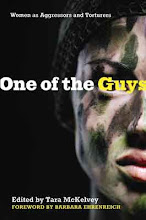
As quoted in one of the books I am reading, One of the Guys, "it's evident that , as a culture, we do not yet understand how to think about women in the military - much less women in combat." It also brings up the thought, or question, (concerning the women soldiers at Abu Ghraib torturing the POWs)..were theses women "more or less feminine than the general population of women? They are likely representative, within the same range of girly to tough as any other sector." "How is the military training shaping women's understanding of themselves in relation to male soldiers, female soldiers, and citizens of the countries where they are deployed? How are women functioning symbolically in the broader debate?"
As quoted in one of the books I am reading, One of the Guys, "it's evident that , as a culture, we do not yet understand how to think about women in the military - much less women in combat." It also brings up the thought, or question, (concerning the women soldiers at Abu Ghraib torturing the POWs)..were theses women "more or less feminine than the general population of women? They are likely representative, within the same range of girly to tough as any other sector." "How is the military training shaping women's understanding of themselves in relation to male soldiers, female soldiers, and citizens of the countries where they are deployed? How are women functioning symbolically in the broader debate?"
September Lecture 1, James Hyde (11am School of Arts Bld.)
I attended the Lecture by James Hyde on the 27th at the School of Arts Building and found myself not very thrilled by his work. He is an abstract painter/installationist, but i for one am not necessarily a huge fan of abstract art to begin with, or at least total abstract art. He work a lot with fresco and acrylic. He decided what he wanted to do at the age of 15, which was an abstract painter, because he thought it would be easy...as he discovered it wasn't. He likes to define it (abstract painting) as a section of reality, and deals with the idea that anything that is important isn't physical. He also finds it important that he has "air moving through his pieces."
Some of the first work he showed us were big blocks of stirafoam, displayed on a wall, painted (frescoed) with different shades of one color. I found them to be dull and uneventful.
The one thing that he did that I found enjoyable was a big series of large painted pillows. By the end of his series the pillows displayed in a gallery were massive, taking up almost the whole gallery space. They were 'abstractly' painted on one side and had clear plastic on the other side, then blown up with air. The pillows were cool, but i mostly enjoyed how they took up the space and seemed to be so intrusive to the viewers.
Overall, I thought he was hard to understand and his work didn't do much for me.
Some of the first work he showed us were big blocks of stirafoam, displayed on a wall, painted (frescoed) with different shades of one color. I found them to be dull and uneventful.
The one thing that he did that I found enjoyable was a big series of large painted pillows. By the end of his series the pillows displayed in a gallery were massive, taking up almost the whole gallery space. They were 'abstractly' painted on one side and had clear plastic on the other side, then blown up with air. The pillows were cool, but i mostly enjoyed how they took up the space and seemed to be so intrusive to the viewers.
Overall, I thought he was hard to understand and his work didn't do much for me.
Subscribe to:
Comments (Atom)